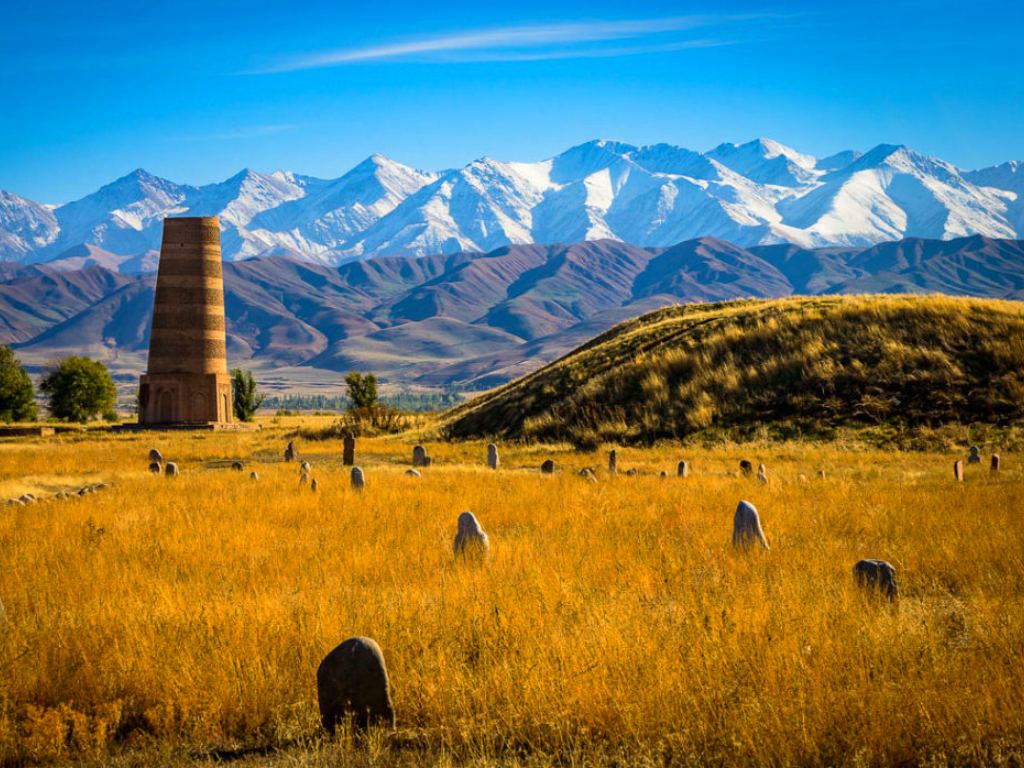
Burana Tower is an ancient minaret located in the Chui Valley, just 80 km from Bishkek and 12 km from Tokmok, on the scenic route to the Kegety Gorge of the Kyrgyz Range, on the left bank of the Chu River.
Today, Burana Tower is part of the protected Burana archaeological and architectural complex, incorporated into the state museum and preserved as a cultural heritage monument of Kyrgyzstan.
History of Burana Tower and the Ancient City of Balasagun
Burana Tower was not merely a standalone minaret; it served as the vertical centerpiece of the ancient city of Balasagun — the northern capital of the Turkic Karakhanid state. The city thrived along the Great Silk Road and was an important religious, trade, and cultural center of Central Asia.
In 1218, Balasagun was captured and destroyed by the Tatar-Mongol armies, and by the 14th century, the city ceased to exist. Burana Tower remains the sole well-preserved witness to the grandeur of this civilization.
One of Central Asia’s Oldest Minarets
Burana Tower is considered one of the oldest fired-brick minarets in Central Asia, dating back to the 10th–11th centuries.
Architectural features:
- Fired brick and arch beams,
- Octagonal stone base,
- Circular shaft narrowing toward the top,
- Decorative bands of patterned brickwork.
Originally 44–48 meters tall, the top portion collapsed due to a strong earthquake. Today, the tower’s height is approximately 21.7 meters, with a diameter of 9 meters.
Karakhanid Architecture
Burana Tower is a striking example of pre-Mongol Central Asian architecture. The facade is made of terracotta bricks arranged in complex geometric patterns. The decorative bands alternate with smooth surfaces, and no pattern repeats, impressing both researchers and tourists.
The octagonal base has niches on each side. Earlier, these were also ornamented, but restoration preserved authenticity by not reconstructing lost elements.
Inside the Minaret and Views of the Chuy Valley
On the south side, at around 5 meters, is the entrance door. From here, a narrow spiral staircase leads to the top. The climb is steep and requires caution, with a more challenging descent.
At approximately 14 meters, a small observation window opens, and above it, panoramic views include:
- The Chuy Valley,
- Kyrgyz Range,
- Surrounding fields and burial mounds of the ancient city.
On clear days, distant mountain peaks create a breathtaking contrast between history and nature.
The “Stone Garden” and Balbals
Adjacent to Burana Tower is the famous open-air “Stone Garden” museum, featuring:
- Balbals (6th–10th centuries) — stone statues with detailed faces, hairstyles, and jewelry,
- Ancient gravestones with Arabic inscriptions,
- Millstones,
- Stones with petroglyphs dating to the 1st millennium BC.
Balbals depict warriors and nobles, providing valuable insights into the culture of the ancient Turks.
The Legend of Monara
Like many ancient sites, Burana Tower has its legends. The most famous tells of Princess Monara:
A khan was warned by an astrologer that his daughter would die from a spider bite before turning 16. To protect her, he built a tall tower and isolated her at the top. On her 16th birthday, the khan brought her grapes; a black spider emerged from the cluster, causing the tragic event.
The khan’s grief supposedly caused the tower to shake and partially collapse, explaining why only half of it remains today.
Archaeological Complex and Museum
Within the complex, visitors can see:
- Foundations of ancient mausoleums shaped like the Greek letter Omega,
- Burial mounds — remnants of the Balasagun palace complex,
- Burana Tower Museum, displaying artifacts from archaeological excavations: ceramics, decorative elements, household items, and historical reconstructions.
Why Visit Burana Tower
If traveling in northern Kyrgyzstan and wondering what to see near Bishkek, Burana Tower is a must-visit:
- A major attraction of the Chuy region,
- A unique monument of the Karakhanid era,
- A place where history, legends, and nature converge.
Burana Tower is more than ruins; it is a point where Kyrgyzstan’s past continues to speak to the present.