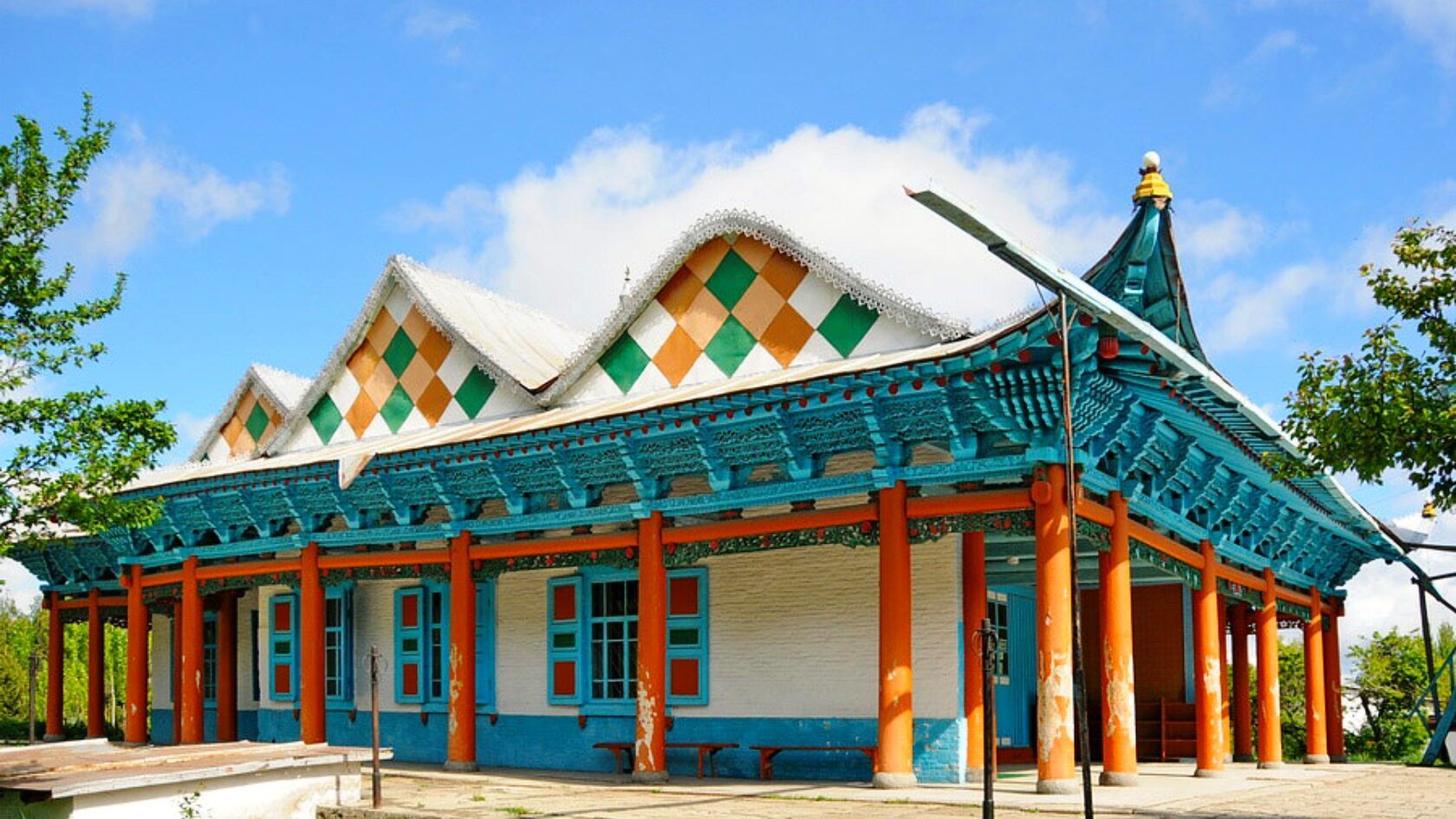
Located on the outskirts of Каракол, among typical Soviet-era buildings, the Dungan Mosque stands out as if transported from another era. Its curved green-blue roof, high cornices, oriental arches, and carved wooden columns immediately draw attention. Built in 1907, it is one of the most unique examples of Chinese wooden architecture in Central Asia and a key landmark of Issyk-Kul.
This mosque is more than a religious building—it is a living chronicle of the Dungan people, carved from wood, memory, and faith.
History of the Dungan Mosque: From China to Kyrgyzstan
In the late 19th century, the Dungans—a Muslim ethnic group of Chinese origin—fled China after brutal persecution following the anti-Qing uprising. Thousands settled in Central Asia, including Пржевальск (today Karakol).
They brought language, traditions, cuisine, and a unique architectural philosophy. For the Dungans, the building itself reflects a philosophy of life, inspiring the creation of a mosque unlike any other in the region.
A Nail-Free Wooden Masterpiece
The mosque was built under master carpenter Zhou Xi from Gansu Province, China. Over three years, more than 30 craftsmen assembled the structure without a single nail, using an intricate system of wooden joints and locks.
Material: high-altitude Tian Shan spruce, known for durability, resistance to cracking, and adaptation to the Issyk-Kul climate. Small gaps were intentionally left so the building could “breathe,” expanding and contracting with the wood.
Even today, the mosque seems alive: it softly creaks, echoes footsteps, and retains warmth in cold weather.
Architecture and Symbolism: Islam in Eastern Form
At first glance, the mosque resembles a Buddhist or Taoist temple. Curved eaves, bright painting, and oriental ornaments reflect Chinese architecture, while Islamic prayers are performed inside.
This deliberate cultural synthesis blends Eastern form with Islamic content.
Symbols on the facade include:
- Waves — movement and life,
- Clouds — spirituality,
- Peony — longevity,
- Dragon — protection and strength.
The roof is supported by 42 wooden columns, symbolizing generations who honor their ancestors. According to legend, Dungan mosques in Central Asia form the body of a mythical dragon: Chinese mosques as the head, a mosque in Kazakhstan as the body, and the Karakol mosque as the tail.
Interior Space and Acoustics
Inside, a spacious prayer hall has no partitions. The floor is carpeted, the ceiling decorated with floral patterns, and a central domed niche hosts the imam during prayers.
Notably, the acoustics are exceptional: sounds dissolve rather than echo, creating a serene, meditative atmosphere. The mosque is oriented precisely westward toward Mecca, determined astronomically as traditional Chinese builders did.
Dungan Community and Modern Significance
Today, Karol’s Dungan community counts about 3,000 people—the descendants of those who built the mosque over a century ago. For them, it is a living center, not just a museum or tourist site.
Here, the community:
- Performs Friday prayers (Jumu’ah),
- Celebrates major religious holidays,
- Supports each other in times of need,
- Manages community matters from charity to family events.
During crises, the mosque served as a center for humanitarian aid. Its entrance has no steps, symbolizing that no one should stumble on the path to God.
Why Visit the Dungan Mosque in Karakol
If you plan a trip to Kyrgyzstan and wonder what to see in Karakol, the Dungan Mosque is a must-visit. It is:
- One of Issyk-Kul’s most unusual attractions,
- A unique architectural monument,
- A living testimony to migration history and cultural dialogue.
While the state protects the building, its true guardians are the people—because the main material is not just wood, but memory.