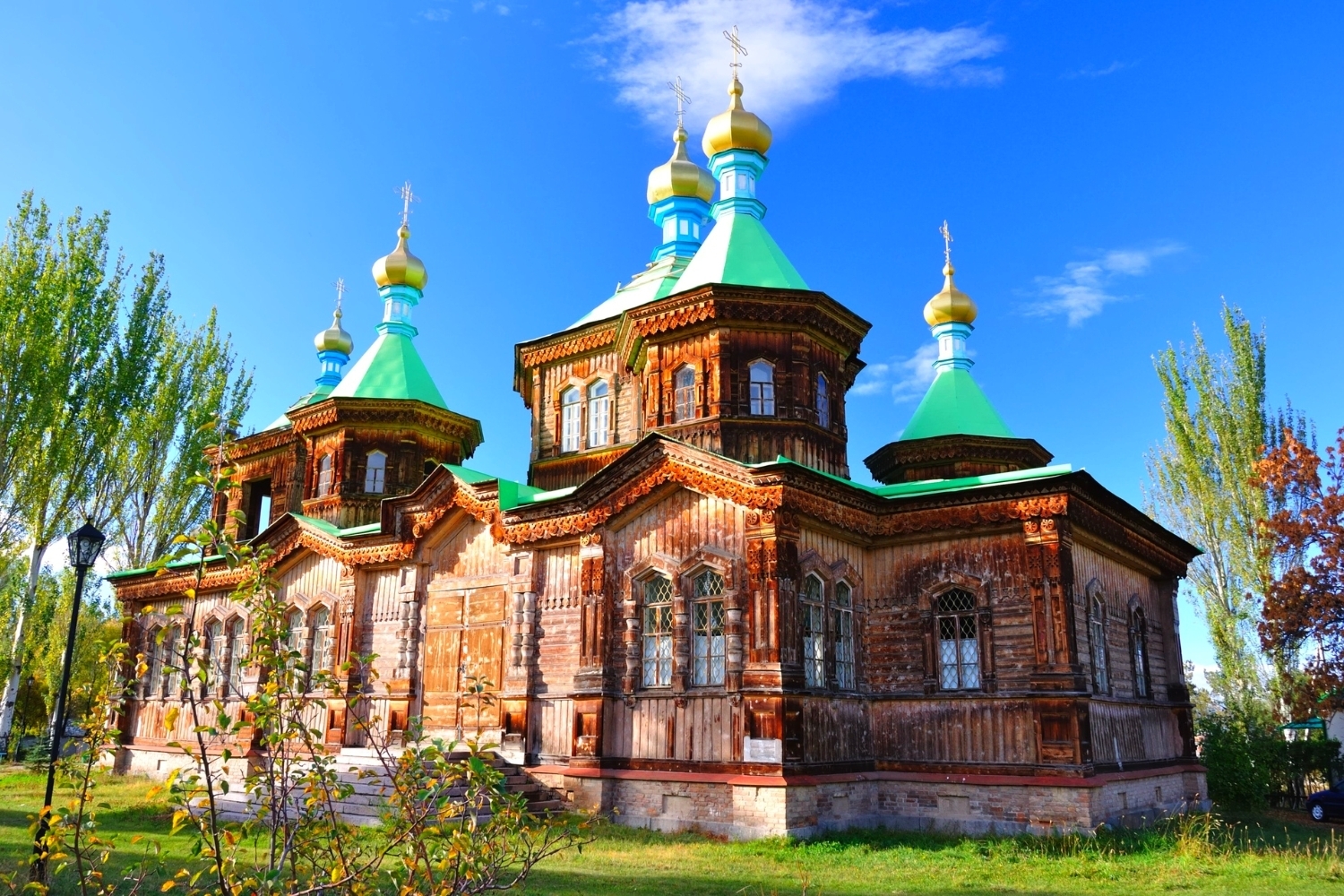
The Holy Trinity Church is one of the main attractions of Каракол and an important Orthodox Christian shrine in Kyrgyzstan. It is located in the city center, at the intersection of Gagarin and Lenin streets, near the central square, and is open to tourists.
History of Karakol and Its First Churches
Karakol was founded in 1869 by Baron A. V. Kaulbars as a military and trade settlement. The first settlers were Russian immigrants for whom spiritual life was of particular importance.
In the same year, a temporary felt church was moved from the Aksu fort to Karakol. By 1870, its walls were replaced with wooden structures, but in the 1870s the church burned down in a fire.
A Church That Survived Earthquakes and Eras
In 1876, a new church made of adobe brick was built on the site and consecrated by Archbishop Sofonia in honor of the Holy Trinity. However, in 1889, the Chilik earthquake completely destroyed the building.
After this catastrophe, it became clear that stone churches in Semirechye were vulnerable to seismic activity. By the late 19th century, the decision was made to return to wooden church architecture, which was more resilient in this region.
Architecture of the Holy Trinity Church
The current Holy Trinity Church was designed by architects from Верный (modern Almaty) and built in 1895 with support from the Maslikov merchant family. It was consecrated the same year.
Key architectural features:
- walls made of wooden logs,
- rich wood carvings,
- decorative paintings,
- five domes crowning the roof.
Despite the decline of wooden church construction in the Russian Empire by the late 19th century, a revival of wooden ecclesiastical architecture occurred in Turkestan and Semirechye, driven by local environmental conditions.
Fate of the Church During the Soviet Period
After the October Revolution, the Holy Trinity Church was closed. The building was converted into a children’s sports school, as happened with many religious sites at the time.
In 1986, a restoration project was approved to convert the church into a local history museum, but due to the collapse of the USSR, the plan was never completed. In 1992, the restored building was returned to the Russian Orthodox Church, and religious services resumed.
The Tikhvin Icon of the Mother of God — Church Treasure
A special place in the church is occupied by the revered Tikhvin Icon of the Mother of God. Painted in 1897 and gifted to the church, the icon was at risk of destruction during years of religious persecution.
Ordinary parishioners secretly preserved the icon, risking their lives. It was finally returned to the church in 1944 and has since been considered a miraculous symbol of salvation and restoration.
Holy Trinity Church Today
Today, the Holy Trinity Church is an active Orthodox parish, a spiritual center, and a significant tourist attraction. Visitors include:
- pilgrims,
- tourists,
- local residents.
The church blends harmoniously into the cityscape and is a striking example of Russian architectural tradition rooted in the heart of the Issyk-Kul region.
Why Visit the Holy Trinity Church in Karakol
If you are wondering what to see in Karakol, the Holy Trinity Church should be on your route. It is:
- one of the oldest Orthodox churches in Central Asia,
- a monument of 19th-century wooden architecture,
- a site with rich and dramatic history,
- a spiritual shrine and architectural gem of the city.
The Holy Trinity Church is living history — it has survived fires, earthquakes, and historical upheavals while preserving faith, beauty, and memory.