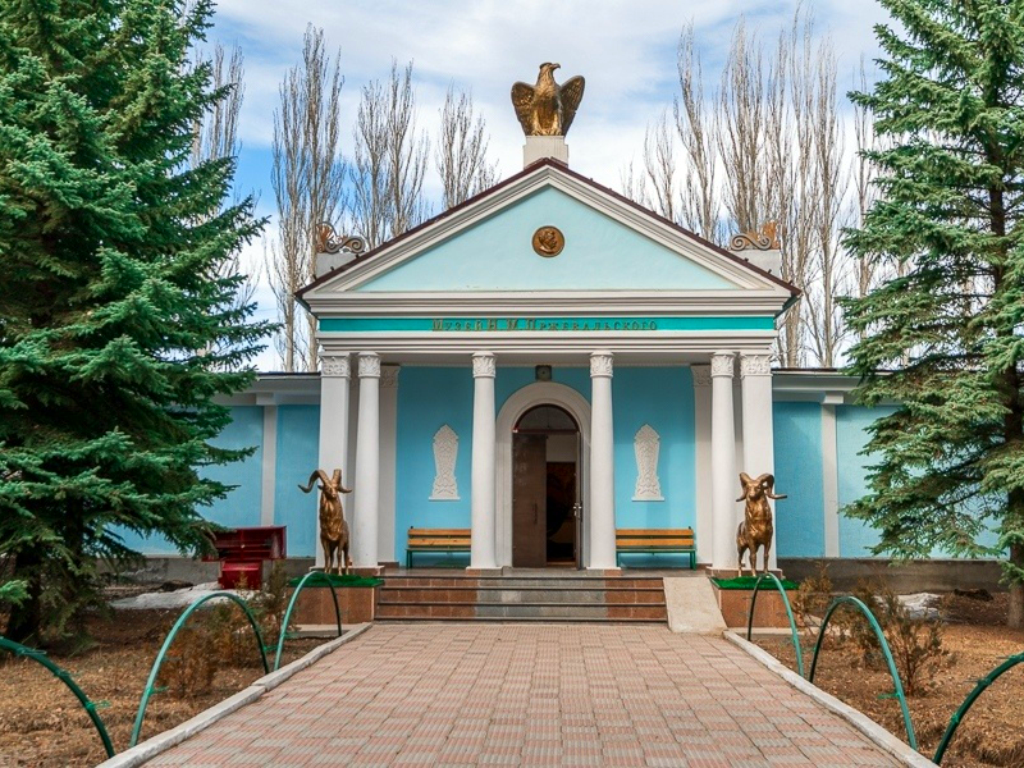
The N. M. Przhevalsky Memorial Museum Complex is one of the most important cultural and historical attractions in the Issyk-Kul region of Kyrgyzstan. Located on the shores of the legendary Иссык-Куль, just 12 km northwest of Каракол, in the village of Pristan-Przhevalsk, the complex marks the burial site of the famous explorer.
Nikolay Mikhaylovich Przheval'skiy — Explorer of Central Asia
Nikolai Przhevalsky (1839–1888) lived a relatively short yet remarkably intense life. He became one of the first Russian and European explorers to reach the most remote and inaccessible regions of Central Asia, Tibet, and Western China.
Tibet held a special place in his scientific work. Przhevalsky provided detailed descriptions of:
- mountain ranges,
- river valleys,
- climate and natural landscapes of the northern territories.
During his expeditions, he collected extensive zoological and botanical specimens, including species previously unknown to science. More than ten biological species were named in his honor, the most famous being the Лошадь Пржевальского — a true symbol of the wild nature of Central Asia.
The Last Expedition and Final Resting Place
In 1888, during another expedition, Przhevalsky died of typhoid fever. According to his personal request, he was buried on the shores of Issyk-Kul — a place he deeply admired.
Today, the memorial complex stands at this very scenic location, and the surrounding area is considered one of the most picturesque spots near Karakol, attracting travelers exploring eastern Kyrgyzstan.
History of the Museum Complex
The museum officially opened in 1957, nearly 70 years after the explorer’s death. However, memorial structures appeared here much earlier.
The centerpiece is an impressive eight-meter monument made of massive stone blocks. The composition is crowned by a bronze eagle holding an olive branch in its talons, perched on a map of Asia — symbolizing geographical discovery and peaceful dedication to science.
Below the monument visitors can see:
- a bas-relief portrait of Przhevalsky,
- a copy of his personalized medal from the Imperial Academy of Sciences.
Museum Exhibition
At the end of the 20th century, the museum’s interior was significantly expanded. Today, its exhibition is considered one of the most informative in the Issyk-Kul region.
Visitors are welcomed by:
- a large globe,
- a ceramic relief map of Asia reflecting accurate geography and mountain systems.
The main exhibition hall features:
- original documents, letters, and manuscripts,
- rare expedition photographs,
- personal belongings of the explorer,
- travel gear and equipment, including his personal rifle,
- zoological displays with animal specimens prepared specifically for the museum.
The exhibition allows visitors not only to learn biographical facts but also to truly understand the scale of Przhevalsky’s personality and the challenges of 19th-century exploration.
Park and Surrounding Area
The museum is surrounded by a well-maintained park, ideal for peaceful walks. Here you will find:
- a shaded tree-lined alley,
- flower beds,
- benches for relaxation,
- a fountain.
The proximity to Lake Issyk-Kul makes this destination especially atmospheric. The combination of water, mountains, and history creates a unique sense of tranquility and depth — an essential experience for cultural tourism in Kyrgyzstan.
Why Visit the Przhevalsky Museum
If you are looking for things to do near Karakol, the N. M. Przhevalsky Memorial Museum Complex is a must-visit attraction in Kyrgyzstan.
It is:
- an important scientific and historical landmark,
- a memorial site dedicated to one of the greatest explorers of Central Asia,
- an engaging and well-curated museum,
- a scenic location on the shores of Lake Issyk-Kul.
For a deeper experience, visiting with a professional guide is highly recommended — it makes the excursion far more informative and engaging.
The Przhevalsky Museum Today
Today, the Przhevalsky Memorial Museum Complex is more than just a museum. It is a place where the history of science, exploration, and the wild landscapes of Central Asia merge into one compelling narrative. Here, visitors clearly understand the price of 19th-century discoveries and why Przhevalsky’s name continues to command respect around the world.